TL;DR
- I spent a year on an analytics platform for Tencent, MiHoYo and other game studios — millions of events a day, dashboards users assemble themselves.
- Every bug that cost me more than an afternoon came from assuming a boundary held: the style sandbox, the main thread, the CDN edge, the meaning of a word.
- The fix was never cleverer code. It was learning where each boundary actually sits, and stopping treating it as someone else's problem.
The platform ingested telemetry from games you have heard of and turned it into dashboards that analysts assembled themselves — drag a chart in, pivot it, filter half a million rows, share the link. My first ticket was a CSS bug. It took two days, and the reason it took two days is the reason I am writing this post.
The stylesheet was scoped. The component was scoped. The bug was real anyway.
The shape of the thing
| Layer | What we ran |
|---|---|
| Shell | A host container loading independent sub-apps at runtime (qiankun) |
| Sub-apps | React + TypeScript, built on Umi.js; Taro.js for the mini-app surface |
| State | Redux inside each app, an internal SDK for anything crossing between them |
| UI | Ant Design, heavily themed |
Nobody shipped "the app." Teams shipped sub-apps, and the shell composed them in the browser at load time. That single decision is where the first three boundaries come from.
Boundary 1: the sandbox is a convention, not a wall
A micro-frontend shell promises isolation. What it actually gives you depends on which isolation you asked for, and the default is the weak one.
qiankun's default style handling scopes a sub-app's stylesheets while it is mounted and rips them out on unmount. That is not the same as isolation. Two sub-apps mounted at once still share one document, one cascade, and — critically — one copy of the Ant Design theme, whose class names are global by design. A sub-app raising a modal's z-index raises everybody's. A team overriding .ant-table-cell padding to fit their layout changes a table three sub-apps away.
Real isolation means opting into strictStyleIsolation (shadow DOM) or experimentalStyleIsolation (runtime selector prefixing), and both cost you something. Shadow DOM breaks any library that portals into document.body — which Ant Design's modals, dropdowns and tooltips all do. Selector prefixing handles that but doesn't touch styles injected at runtime.
There is no setting that means "isolated, free." What I actually learned here is smaller and more useful than the config flag: in a shared runtime, a global selector is an API you didn't document. Once I started reading .ant-table-cell as a public interface rather than an implementation detail, the class of bug stopped surprising me.
Boundary 2: the main thread doesn't care whose code it is
The dashboards let users pull real result sets — the pathological case being a table around 500,000 rows. Rendering that is the easy half; the DOM only ever holds the visible window once you virtualize it.
The half that actually hurt was everything before render. Parsing the response, reshaping it for the grid, running the filter — all of it synchronous, all of it on the one thread that also owns scrolling. Virtualize a 500K-row table and you get a beautiful 60fps list that freezes solid for two seconds every time someone types in the filter box.
So the fix came in three parts, and the order matters:
- Profile first. The React DevTools flame chart tells you which components re-render; the Performance panel tells you what actually blocked the frame. They disagree more often than you'd expect, and the second one is the one users feel.
- Move the work off the thread. Parsing and reshaping went to a Web Worker. Filters got debounced, so a burst of keystrokes costs one pass instead of eight.
- Memoize last.
useMemoanduseCallbackon the heavy visualization components — genuinely useful, and genuinely the smallest of the three. Memoization stops you redoing work; it never makes the work cheap.
That got us under three seconds to interactive at 60fps on the heavy dashboards. The habit I kept is the ordering: reach for the thread boundary before the render boundary, because a component that re-renders too often is annoying and a main thread that blocks is broken.
Boundary 3: your machine is not the deployment target
Two versions of this, both humbling.
The first is geography. Our stakeholders were in China; I was in Kuala Lumpur. A bundle that loads fine over my connection is a different artifact when it crosses into a network with its own routing and its own idea of which origins are reachable. Asset hosts that resolve instantly here can stall there. "It works locally" and "it works from Shenzhen" are separate claims, and only one of them was in my test loop for the first few months.
The second is the browser matrix. Enterprise clients meant Safari and IE11 were in scope, which is less a technical constraint than a design one — it decides which CSS features you get to use before you write any. The lesson wasn't the polyfills. It was that "supported browsers" is a product decision that arrives disguised as a build config.
Boundary 4: a translated word is not the same word
The most expensive boundary was the one I didn't think of as technical.
Specs, review comments and half the design discussion were in Chinese. I could read it. That turned out to be the trap — reading it produced a translation that felt complete, so I never asked the follow-up.
Two examples that cost me rework:
- 落地 (luòdì) — literally "to land." Every dictionary says "implement." But in a spec review it carries a stronger claim than the English word does: shipped, in production, and actually being used. I read it as "we'll build it." It meant "this is done when someone is using it."
- 颗粒度 (kēlìdù) — "granularity." In an architecture discussion this was almost always about component scope: how much responsibility one piece owns. I heard the abstract noun and nodded. The sentence was asking me to make a decision.
Both times the English translation was correct and useless. So I started keeping a glossary — not a dictionary, a note of what each term meant in our reviews, with the sentence I first heard it in. It's the single highest-return thing I did that year, and it is roughly forty lines long.
The general version: when you're the one working across the language boundary, passive comprehension feels like understanding right up until the sprint where it isn't. Restating the requirement back in your own words is the cheapest possible test, and it's the one I wasn't running.
What I'd tell first-year me
Three things.
Read the system, not the file. The instinct from university is to find the file with the bug in it. In a composed runtime the bug is usually in the space between two files that were each written correctly.
Find out where the boundary actually is before you trust it. Not what the docs promise — what the config you're running actually enables. Style isolation, thread isolation, network reachability, shared vocabulary: in every case I was defended by something weaker than I assumed, and finding that out took ten minutes I kept not spending.
Boring infrastructure compounds. The change with the best ratio of effort to payoff wasn't any of the above; it was containerizing the dev environment and cutting setup from about half a day to half an hour. Every new joiner got that back, permanently.
The composed-runtime lesson is the one that transferred. I've since worked in stacks with no qiankun anywhere in them and hit the exact same shape of bug — two things sharing a namespace that each believed they owned.
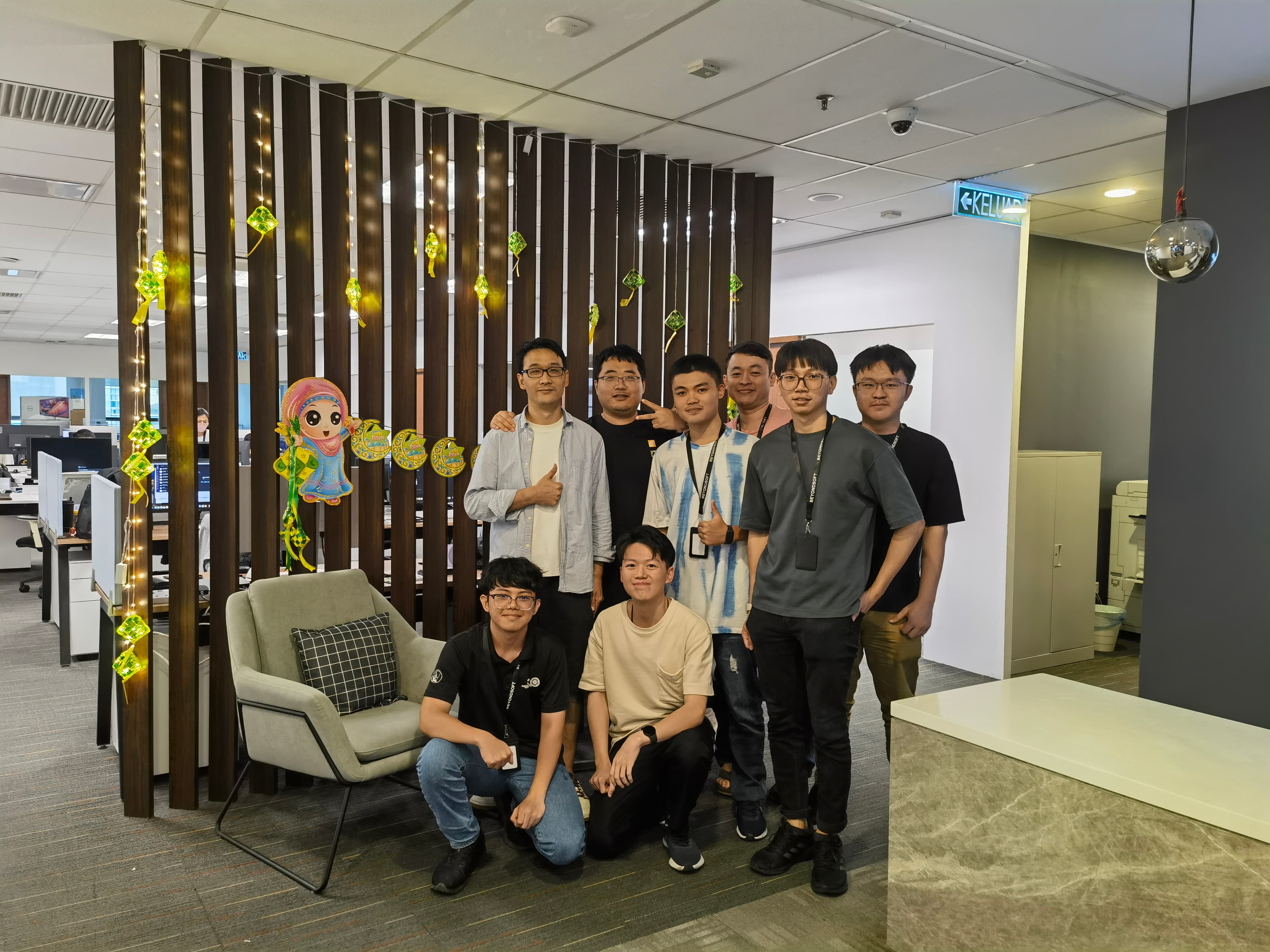
A few photos from that year — the Databrain team and the wider office.
 01/02
01/02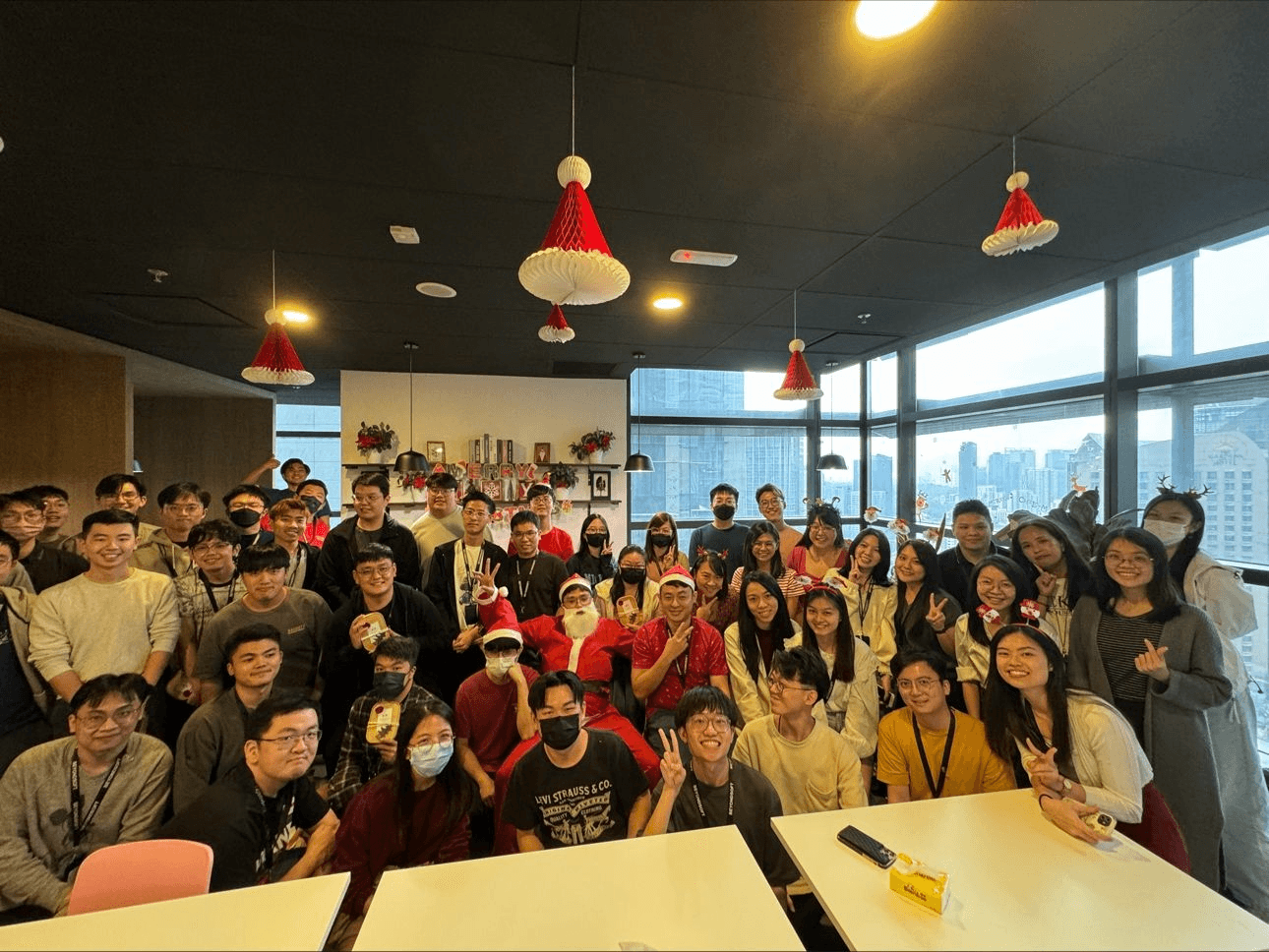 02/02
02/02